 Home / Resources / Blog Articles / Why MJF Custom Parts Are the Smart Choice for High-Performance Manufacturing
 December 12, 2025
Share:
December 12, 2025
Share:


In today’s competitive global manufacturing landscape, buyers are no longer looking only for low prices. They demand consistency, repeatability, tight tolerances, and the ability to move quickly from design to production. This is where MJF custom parts stand out as a highly practical and scalable solution for industrial applications.
Multi Jet Fusion (MJF) technology has become a preferred option for engineers, product designers, and procurement teams who need functional plastic components that perform reliably in real-world environments. Unlike many other additive manufacturing methods, MJF custom parts combine design freedom with production-grade mechanical properties, making them suitable not only for prototypes but also for end-use components.
This article explores MJF custom parts from a professional manufacturing and sourcing perspective, focusing on material performance, design flexibility, production consistency, surface quality, dimensional accuracy, and real industrial use cases—without discussing history, challenges, or future trends.
At its core, MJF is designed to produce parts that behave more like traditionally manufactured components rather than fragile prototypes. This is the key reason why MJF custom parts are increasingly specified directly in engineering drawings.
One of the defining advantages of MJF custom parts is isotropic strength. Mechanical properties are consistent in all directions, which means parts do not suffer from weak Z-axis bonding commonly seen in other 3D printing technologies. This makes MJF custom parts especially suitable for load-bearing structures, snap-fit assemblies, and functional housings.
From a buyer’s standpoint, this consistency reduces design risk. Engineers can rely on predictable strength, stiffness, and dimensional stability across batches, which is essential for industrial production and long-term supply agreements.
Material selection plays a decisive role in the success of any custom-manufactured component. MJF custom parts are typically produced using advanced thermoplastic powders that are optimized for strength, durability, and environmental resistance.
Commonly used materials for MJF custom parts offer:
High tensile strength suitable for mechanical assemblies
Excellent fatigue resistance for moving or load-cycling parts
Good chemical stability for exposure to oils, greases, and cleaning agents
Stable thermal behavior for applications involving moderate heat
These material characteristics allow MJF custom parts to be used confidently in industrial environments such as manufacturing equipment, automation systems, and transportation components.
Another important factor is material uniformity. Because MJF processes distribute energy and fusing agents evenly across the powder bed, material density is highly consistent throughout the part. This eliminates internal voids and weak spots, ensuring MJF custom parts perform reliably under stress.
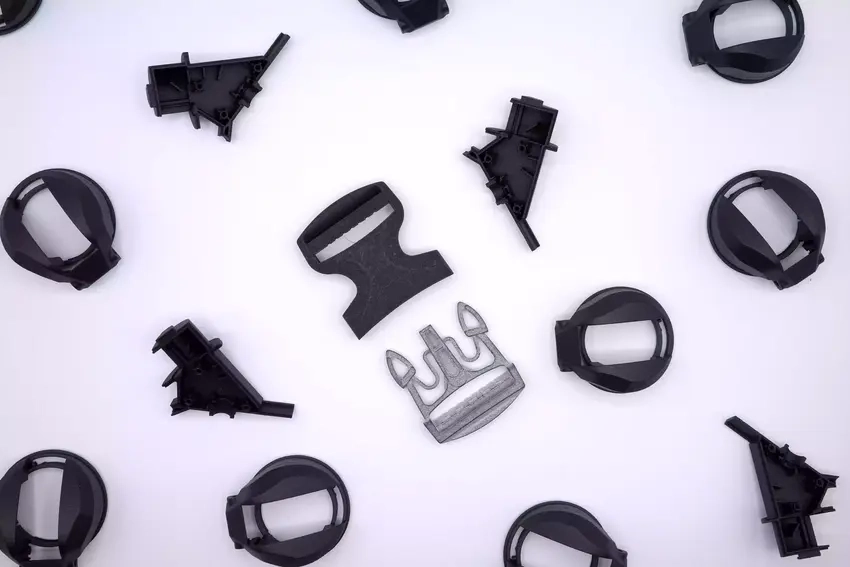
One of the most practical advantages of MJF custom parts is the ability to produce complex geometries without additional tooling cost. Internal channels, lattice structures, living hinges, and integrated mounting features can be manufactured in a single build.
For engineers, this opens the door to functional design optimization. Instead of assembling multiple components, MJF custom parts can consolidate several functions into one part, reducing assembly time and potential failure points.
Importantly, this design freedom does not come at the expense of mechanical performance. MJF custom parts maintain high strength even in thin-walled or geometrically complex sections, making them ideal for compact assemblies where space efficiency matters.
Precision is a non-negotiable requirement for professional manufacturing. MJF custom parts are known for their excellent dimensional accuracy, which is critical for parts that must interface with metal components, fasteners, bearings, or electronic modules.
Typical tolerances achieved by MJF custom parts are tight enough for most industrial applications without secondary machining. This consistency also supports batch production, where hundreds or thousands of identical parts must meet the same dimensional specifications.
For international buyers, repeatability is especially important. MJF custom parts allow manufacturers to deliver stable quality across multiple production runs, enabling long-term sourcing partnerships without frequent design adjustments or revalidation.
Out of the printer, MJF custom parts already offer a uniform and professional surface appearance. The fine powder resolution results in smooth surfaces compared to many other additive manufacturing methods.
In addition, MJF custom parts support a wide range of post-processing options, including:
Surface smoothing for improved tactile feel
Dyeing for consistent, production-ready color
Coating for enhanced wear or chemical resistance
Precision finishing for visible or consumer-facing components
These finishing options make MJF custom parts suitable not only for internal industrial use but also for applications where appearance and brand perception matter.
Traditional manufacturing methods often require expensive molds or tooling, which makes low- to medium-volume production inefficient. MJF custom parts eliminate this barrier by enabling direct digital manufacturing.
For businesses that require frequent design updates or multiple part variations, MJF custom parts offer unmatched flexibility. Design changes can be implemented instantly without additional tooling cost, reducing both lead time and financial risk.
This efficiency is particularly valuable for:
Customized equipment components
Short-run industrial assemblies
Replacement parts and service components
Product variants for different markets
With MJF custom parts, companies can align production volume precisely with demand, avoiding excess inventory and reducing storage costs.
MJF custom parts are widely chosen for functional applications because they behave predictably under mechanical load. Their balanced strength and flexibility make them suitable for parts that must endure vibration, impact, and repeated use.
Examples of functional features commonly integrated into MJF custom parts include:
Snap-fit joints that maintain elasticity over time
Threaded inserts and fastening interfaces
Structural ribs for stiffness enhancement
Mounting brackets and enclosures
This mechanical reliability allows MJF custom parts to replace injection-molded components in many scenarios, especially when production volumes do not justify tooling investment.
One overlooked benefit of MJF custom parts is uniform performance across complex shapes. In many manufacturing processes, geometry complexity introduces variability in strength and quality. MJF technology minimizes this issue by fusing material evenly throughout the entire build volume.
As a result, MJF custom parts maintain consistent wall thickness behavior, predictable deformation characteristics, and stable dimensions—even in intricate designs. This reliability simplifies engineering validation and reduces the need for extensive physical testing across design variations.
MJF custom parts are widely used across multiple industries where functional performance and customization are equally important. Typical application areas include:
Industrial automation components such as brackets, housings, and guides
Mechanical assemblies requiring lightweight yet strong parts
Electrical and electronic enclosures with integrated mounting features
Custom fixtures, jigs, and tooling aids for manufacturing operations
Transportation and mobility components with complex geometries
In each of these applications, MJF custom parts deliver a balance of strength, accuracy, and customization that is difficult to achieve with traditional manufacturing alone.
From a procurement perspective, MJF custom parts simplify the supply chain. Digital production files eliminate the need for physical molds, reduce dependency on tooling suppliers, and shorten lead times.
This digital-first approach allows manufacturers to respond quickly to customer demand, design updates, or specification changes. For international buyers, MJF custom parts also reduce logistics complexity by enabling localized or on-demand production.
Furthermore, because MJF custom parts are produced directly from validated CAD data, quality control becomes more predictable and traceable, which is essential for professional sourcing and long-term cooperation.
Professional buyers place high importance on quality assurance. MJF custom parts support standardized production parameters, which leads to stable output quality across batches.
Key quality-related benefits include:
Controlled thermal conditions during production
Uniform material fusion and density
Reduced warping and internal stress
Reliable dimensional repeatability
These factors contribute to a manufacturing process that is suitable for certified production environments and industrial-grade quality systems.
When evaluated purely on performance, efficiency, and reliability, MJF custom parts offer a compelling value proposition. They bridge the gap between prototyping and production, allowing companies to move faster without sacrificing quality.
Engineers appreciate the design freedom and predictable performance, while buyers value the cost transparency, short lead times, and reduced tooling investment. Together, these advantages make MJF custom parts a practical solution for modern manufacturing needs.
MJF custom parts are not just an alternative manufacturing method—they are a professional production solution for businesses that demand functional performance, customization, and supply chain flexibility.
By combining strong and consistent materials, high dimensional accuracy, excellent surface quality, and efficient production workflows, MJF custom parts meet the expectations of engineers, procurement teams, and end users alike.
For companies seeking reliable, production-ready custom components without the constraints of traditional tooling, MJF custom parts represent a smart, scalable, and technically sound manufacturing choice.

 Language
 English
 German
 French
 Spanish
 Italian
 Dutch
Dutch Polish
 Portuguese
 Russian
 Czech
Czech Swedish
 Danish
 Arabic

 Email
Email WhatsApp